
In the age of GPS, does Palm Desert still need wayfinding signs?
City Council members question a nearly $3 million plan to replace aging signs, asking whether the money could be better spent while backing new entry monuments.
Do Palm Desert drivers still need signs pointing them toward local landmarks and attractions in an age when nearly everyone has a GPS in their pocket?
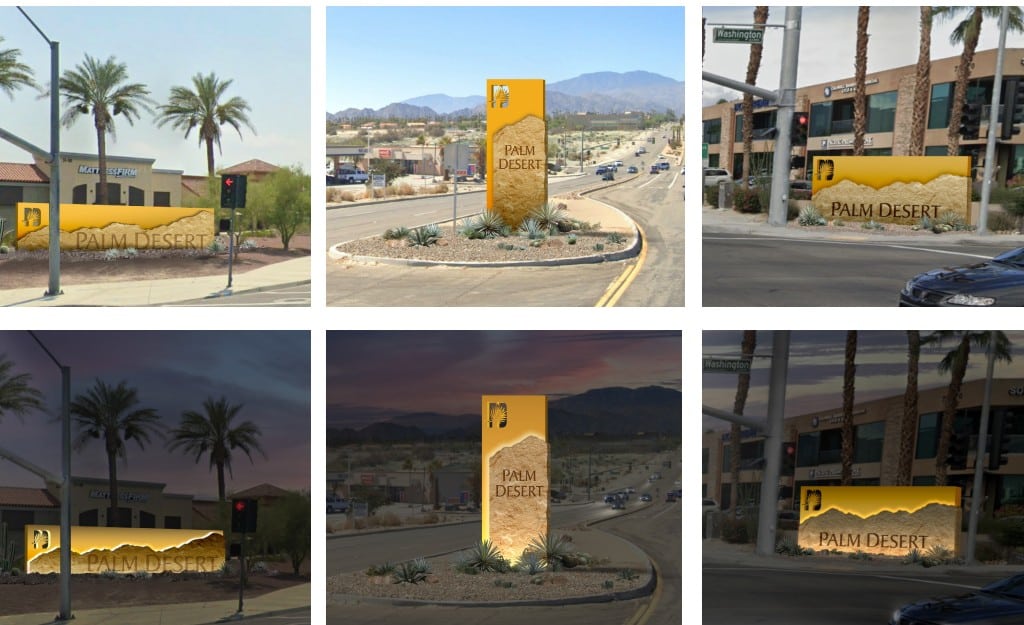
That question was at the center of a City Council discussion last month over a nearly $3 million proposal to replace the city’s aging wayfinding signs and install new entry monuments. Rather than approve the project, council members asked staff to return with separate price tags for each component.
The proposal called for awarding a $2.43 million design-build contract to Best Signs Inc., plus a $500,000 contingency. The work would include replacing the city’s 78 existing wayfinding signs with 58 new ones, relocating two public art entry monuments and installing three new entry monuments, including one at Cook Street and Interstate 10.
Public Works staff said the project was within budget and would take about 15 months to complete once the contractor received notice to proceed.
The existing wayfinding signs, approved in 2008, have seen better days, according to staff. Many are faded or leaning, and some have destination names covered. The council directed staff in 2023 to develop a replacement plan, but several members now question whether a wholesale replacement is necessary.
Councilmember Jan Harnick, who asked whether the cost of the entry monuments could be separated from the rest of the project, said she supports the monuments as a way to maintain consistent city branding. But she was less convinced that the wayfinding signs need replacing, particularly given the council’s earlier discussion about the city’s budget and reserves.
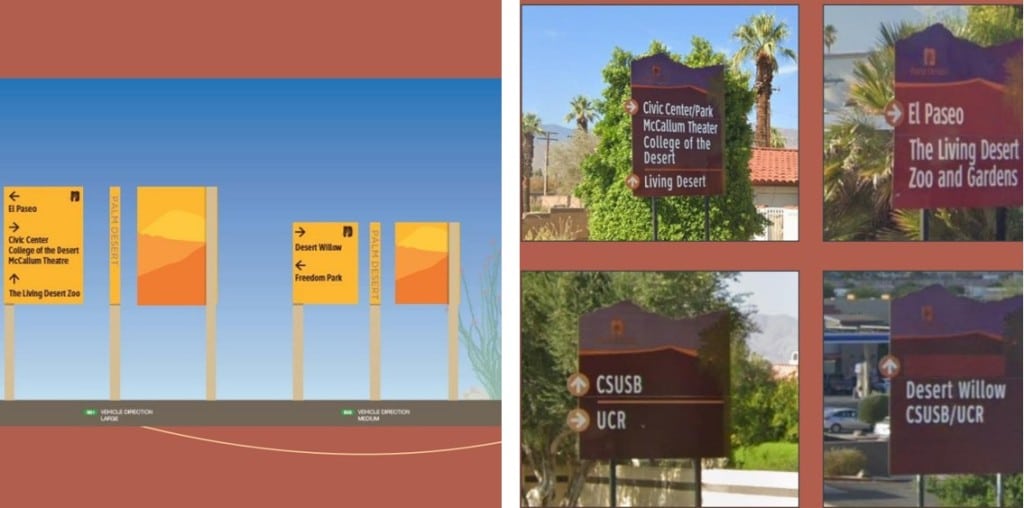
A Public Works staff member said the contractor’s proposal includes some individual costs but combines construction expenses for the two types of signs.
Mayor Evan Trubee was even more skeptical of the wayfinding program, saying he would be fine to “let the wayfinding sign program die its own death.”
Trubee said he doesn’t see similar signs in neighboring cities and questioned their usefulness when most drivers rely on navigation apps to get around.
Councilmember Karina Moreno agreed that the city probably doesn’t need all 58 proposed wayfinding signs, but she wasn’t ready to eliminate them entirely. She suggested retaining essential signs directing people to destinations such as the library or a hospital.
“To me, the monument signs are non-negotiable,” Moreno said.
She proposed having staff return with three separate cost estimates: one for the full wayfinding replacement program, another for a scaled-back version and a third for the entry monuments.
Trubee seconded the motion, saying residents should be able to see the council weighing the options against actual costs. The motion carried.
The money is available, but it isn’t necessarily tied to the sign project. In response to council questions, officials said the work would be funded through former redevelopment agency bond proceeds, which could also be used for other eligible projects within the former agency’s scope, including a park.
For now, the signs will stay where they are while the council waits to see what each option would cost.
Author

Related Articles
Palm Desert committee recommends accepting historic survey that found 142 eligible resources
The Historic Preservation Committee also backed a 2027 work plan that includes studying a tiered designation process. City staff say they can handle its four priorities without significant new budget.

Palm Desert council votes to move ‘Taffy’ sculpture to planned Dave Irwin Park
The 4-1 vote keeps the loaned artwork off a Civic Center Park sports field, but staff must still return with confirmed costs, funding and a final location in the planned north Palm Desert park.

Palm Desert council opts to pursue long-term library at College of the Desert
The 4-1 vote sends staff to negotiate with the college instead of building a $45 million library on the former Parkview site; a renovation is preliminarily estimated at $24 million.