
Palm Desert panel’s landmark rejection spurs debate over preservation process
Members say the debate over a 1956 home’s altered exterior exposed deeper flaws in the city’s landmark process, reviving calls for a tiered system and application overhaul.

Rejection of a historic landmark bid for a 1956 home led Palm Desert’s Historic Preservation Committee to renew calls for a tiered designation system and criticize gaps in the city’s application process.
The committee voted 4-2 at its last regular meeting in June against recommending that the City Council designate the property at 47550 Silver Spur Trail as a local historic landmark.
Bobby Keatinge, an associate planner with the city’s Development Services Department, told the committee the home, built in 1956, originally served as the sales office and model home for the Silver Spur Ranch subdivision. Staff recommended the designation under criteria A and C of the city’s municipal code, citing the property’s association with the city’s post-war residential growth and its mid-century ranch architecture.
The property underwent a 2022 renovation that removed vertical wood siding, enlarged window openings and simplified decorative details, according to Keatinge’s presentation. Property owner Corina Morrison told the committee those changes were made for practical reasons before she considered seeking the designation.
“We did the renovations on the house before we even considered applying for this,” Morrison said, adding that replacing the wood siding was “more of a safety, fire safety thing.”
Commissioner Rachelle McCune argued the alterations left too little of the original structure intact to qualify as a landmark.
“With the windows gone, the roof, the windows, and the stanchions have been changed, the exterior only vaguely looks like it was,” McCune said. “It’s been changed substantially.”
Following the vote, McCune renewed a call for Palm Desert to adopt a two-tiered historic designation system, separating landmark status from a lesser “historic merit” category, a structure she said other cities already use.
“This building could possibly be considered historic merit, but I don’t see it being considered a landmark with as much changes that have been made to it,” McCune said. She added that without a tiered system, “we’re going to have more and more inappropriate applications, and it’s going to be harder and harder to say no to them.”
The same meeting saw committee members criticize the city’s online landmark application system, which they said omits information gathered under the previous paper application, including a required architectural description and a section for applicants to specify which designation criteria they are seeking.
Keatinge told the committee that as the city transitions applications into a new permit portal, “we are continually adding fields that existed in the paper applications,” and acknowledged the online submission for a separate landmark request lacked narrative detail that should be included going forward.
Incomplete applications have placed a burden on staff to fill in missing information rather than sending applications back to applicants for revision, one committee member pointed out
McCune said the quality of applications has declined in the two years since the city moved to the online system.
“I just feel sad that our standards have lowered,” McCune said. “I feel like our standards have lowered in the past two years.”
In other action, the committee voted 5-1 to recommend a separate property, at 73411 Bercera Way, for landmark designation, a 1957-58 desert modern residence built by Roberts Construction Company.
Author

Related Articles
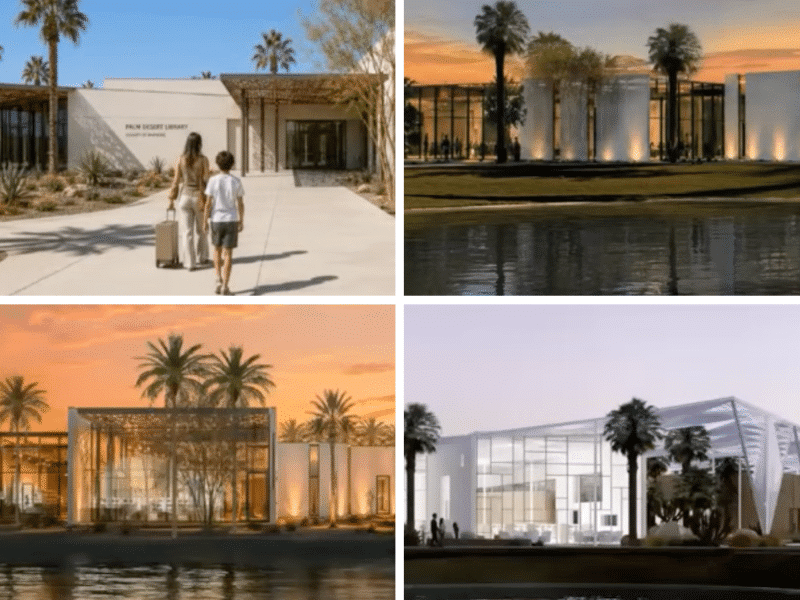
Palm Desert weighs cheaper design for new library
City Councilmembers backed exploring cost-saving design changes Thursday as the city works to bring the long-planned library project within budget and address rising demand for library services.

Palm Desert council backs new commercial compliance program along El Paseo, Highway 111
Palm Desert is shifting from complaint-based enforcement to regular business inspections with a new dedicated commercial compliance officer.

Palm Desert parks committee approves work plan prioritizing trails, playgrounds and shade
Trail connectivity ranked as the top initiative for 2026-27, as a design is already underway linking two city parks along an existing path.